Central Portugal · 9 min read
Can You Visit Fátima, Batalha, Nazaré and Óbidos in One Day from Lisbon?
Yes, it can be done — with an early start, the right order and honest expectations about how long each place deserves. Here is the route I use.
Written by Eduardo Silveira, Portuguese tour guide and founder of Heart & Soul Tours. Published

It is one of the questions I am asked most often by people staying in Lisbon: can we see Fátima, Batalha, Nazaré and Óbidos in a single day?
The honest answer is yes. I do this route regularly, and it works well. But it only works with an early start, a sensible order and a clear idea of how much time each place really needs. Try to treat all four as long, unhurried visits and the day falls apart somewhere around lunchtime.
Planning to explore these destinations? Discover our private tours from Lisbon.
Is it realistic to visit all four places in one day?
It is realistic because the four places sit close together north of Lisbon, and because they are so different from each other. You are not seeing four versions of the same thing.
Fátima is a place of pilgrimage. Batalha is a monument — one of the great Gothic buildings in Europe. Nazaré is the Atlantic: cliffs, a fishing town and, in the right conditions, enormous waves. Óbidos is a small medieval town inside its walls. Each one asks something different of you, and that variety is what keeps the day from feeling repetitive.
What makes it demanding is the clock. Between Lisbon and the furthest point of the route you will spend a fair part of the day in the vehicle, and every stop has to earn its time. That means deciding in advance where you want to linger and where a shorter visit is enough.
The best route from Lisbon
I start with Fátima and work back towards Lisbon, finishing in Óbidos. Going north first means you reach the Sanctuary in the morning, before the larger groups, and the drive home in the late afternoon is the shortest leg of the day.
The times below are the suggested itinerary I work to, not a guarantee. Traffic leaving Lisbon, ceremonies at the Sanctuary, the weather and simply how much you are enjoying a place all move things by half an hour here and there. That is normal.
08:00
- Suggested time
- Pick-up in Lisbon
- What happens
- We leave the city before the worst of the traffic.
Around 09:30
- Suggested time
- Fátima
- What happens
- The Sanctuary and the Chapel of the Apparitions.
Around 11:00
- Suggested time
- Batalha
- What happens
- The Monastery of Santa Maria da Vitória.
Around 12:30
- Suggested time
- Nazaré
- What happens
- Lunch, the beachfront and Sítio da Nazaré.
Around 15:15
- Suggested time
- Óbidos
- What happens
- The walls, the lanes and a glass of ginjinha.
Late afternoon
- Suggested time
- Return to Lisbon
- What happens
- Arrival time depends on traffic.
| Suggested time | What happens | |
|---|---|---|
| 08:00 | Pick-up in Lisbon | We leave the city before the worst of the traffic. |
| Around 09:30 | Fátima | The Sanctuary and the Chapel of the Apparitions. |
| Around 11:00 | Batalha | The Monastery of Santa Maria da Vitória. |
| Around 12:30 | Nazaré | Lunch, the beachfront and Sítio da Nazaré. |
| Around 15:15 | Óbidos | The walls, the lanes and a glass of ginjinha. |
| Late afternoon | Return to Lisbon | Arrival time depends on traffic. |
Stop 1 — Fátima
We aim to arrive around 9:30. At that hour the Sanctuary is calm, and you understand its scale: the vast open esplanade, the Basilica of Our Lady of the Rosary at one end and the modern Basilica of the Holy Trinity at the other.
The heart of it all is small. The Chapel of the Apparitions marks the place where, between May and October 1917, three shepherd children — Lúcia, Francisco and Jacinta — said they saw the Virgin Mary. Within a few decades a rural parish became one of the most important Catholic pilgrimage sites in the world.
You do not need to be religious to find Fátima moving. Pilgrims walking the long path on their knees, candles burning near the chapel, the silence during a Mass — it is a working place of faith, not a museum. I ask guests to dress and behave accordingly, and I explain the history quietly rather than over the top of it.
Stop 2 — Batalha
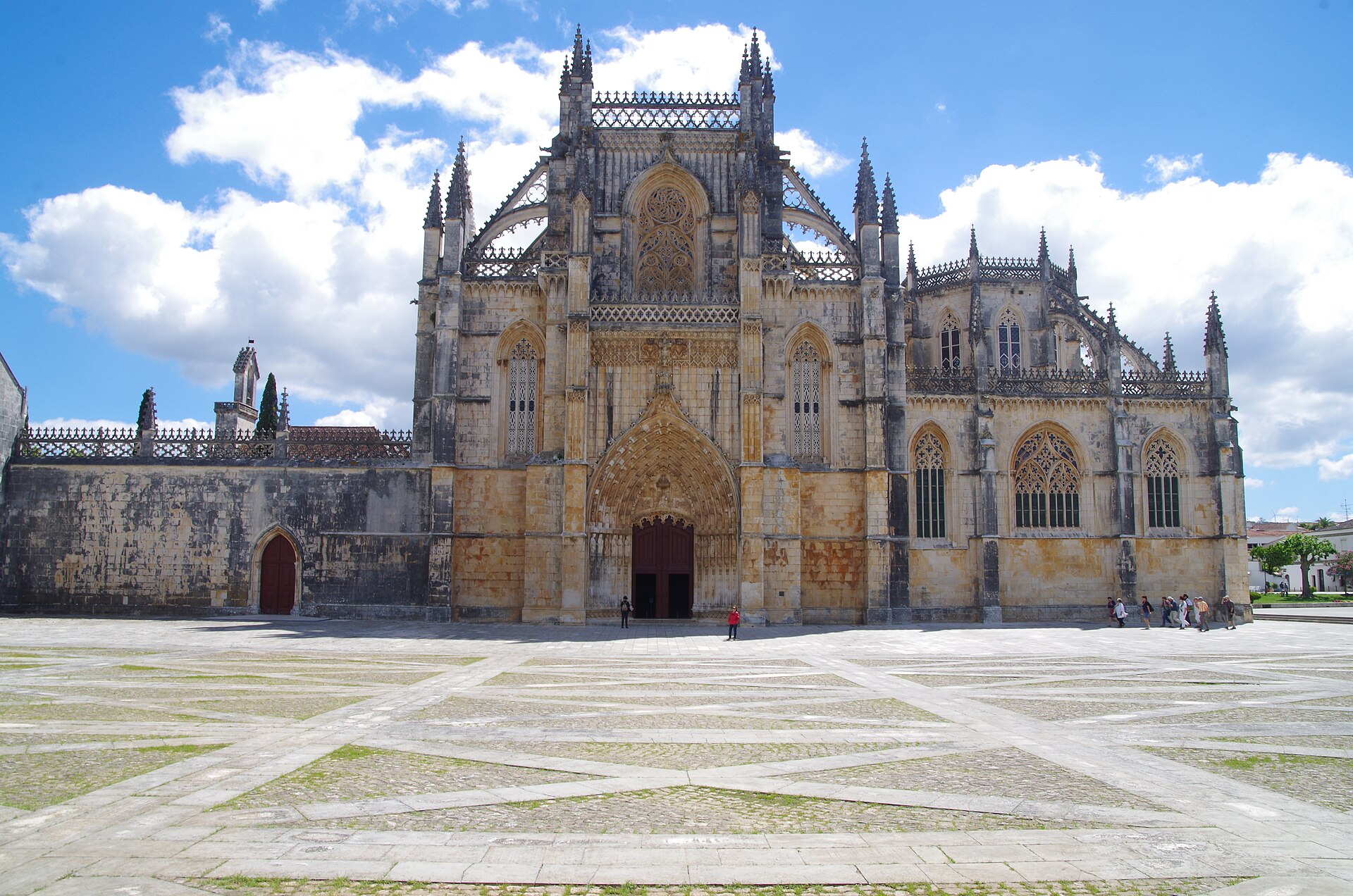
Batalha means “battle”, and the Monastery of Santa Maria da Vitória exists because of one. In 1385 King João I defeated a Castilian army at Aljubarrota, not far from here, and secured Portugal's independence. He promised to build a monastery in thanks, and the result took well over a century to complete.
It is a masterpiece of Portuguese Gothic, later enriched with Manueline detail, and it is a UNESCO World Heritage Site. Inside you find the Founder's Chapel, where João I and his English queen, Philippa of Lancaster, lie side by side, and the Unfinished Chapels — open to the sky, because the roof was never built.
This is not a roadside photo stop. I plan a proper visit here, and I explain why further down.
Stop 3 — Nazaré

Nazaré is two places. Down below is the fishing town and its long beach. Up on the cliff is Sítio da Nazaré, reached by road or by the old funicular, with a viewpoint over the whole bay that never disappoints.
From Sítio we continue to the lighthouse and the view over Praia do Norte. This is where the famous giant waves break, driven by a deep underwater canyon just offshore. The big-wave season is roughly from autumn to early spring, but the sea decides — on many days, even in winter, the ocean is simply powerful rather than spectacular. I would never promise anyone a giant wave.
Nazaré is also a town with deep fishing traditions. You may still see older women in the traditional layered skirts, and fish laid out to dry on racks on the beach. It is still very much a living town, not a stage set.
Stop 4 — Lunch in Nazaré
Nazaré is where I stop for lunch, and I recommend giving it time. Fresh fish, grilled sardines in season, a seafood rice — this is the place for it. Lunch is not included in the tour price, and I am happy to suggest somewhere suited to your taste and budget.
Afterwards, a relaxed walk along the beachfront helps. Depending on the day, I sometimes go up to Sítio before lunch and sometimes after; the order inside Nazaré is something I adjust on the spot.
Stop 5 — Óbidos

Óbidos is the final stop and the closest to Lisbon. It is a small medieval town still enclosed by its castle walls, with whitewashed houses edged in blue and yellow, bougainvillea over the doorways and narrow cobbled streets that climb towards the castle.
The main street, Rua Direita, is lined with shops selling ginjinha, the local sour-cherry liqueur, often served in a small chocolate cup. It is worth stepping off it into the side lanes, which are far quieter.
A word of caution about the walls. You can walk along them, and the views are lovely, but many sections are narrow and have no railing on the inner side. I do not recommend them for young children, anyone unsteady on their feet or anyone uncomfortable with heights — and never in wet or windy weather.
By this point of the day the visit is shorter, usually under an hour. That is enough to walk the town and taste the ginjinha, but it is not a full afternoon. If Óbidos is a priority for you, tell me in advance and we can shift time towards it.
What about visiting Batalha Monastery?
This is the stop people most often underestimate. From the car park it looks like a beautiful church you can photograph in five minutes and leave. Many tours treat it exactly that way.
The church itself is open to visitors and well worth stepping into. But the most remarkable parts — the Royal Cloister, the Chapter House with its unsupported vault, and the Unfinished Chapels — are behind a ticketed entrance. The ticket is not included in the tour price, and it is worth buying. Rushing through them misses the point of coming.
Timing matters for that reason. Arriving late morning, after Fátima, gives the visit room without pushing lunch too far. If Batalha is the stop you care about most, I would rather shorten another part of the day than shortchange this one.
Should you do this trip independently or with a private guide?
I will be fair about this, because all three options can work.
A rental car gives you freedom and is the cheapest way to cover four places in a day. The motorways are good. The downsides are parking in Fátima and Nazaré in busy periods, the narrow streets near Óbidos and the fact that the driver spends the day concentrating on the road. I wrote more about that in why travellers sometimes wish they had not rented a car.
Public transport is fine for one destination. Buses from Lisbon reach Fátima, Nazaré and Óbidos separately, but connecting all four in one day is, in practice, not possible. If you only want one of them, it is a perfectly good choice.
A private guided tour costs more, but you travel directly from door to door, the timing adapts to you, and you have someone explaining what you are looking at. Whether that is worth it depends on your trip — I tried to answer that honestly in is a private tour in Portugal worth it.
Why travel this route with a local guide
On a route this full, the advantages are practical. The timing is flexible: if you want longer in Batalha or less in Nazaré, we change it on the day. The transport is direct, with no parking to find and no bus timetables to match. And the history is there when you want it — Aljubarrota, the 1917 apparitions, the fishing traditions of Nazaré — without anyone reading from a script.
That is how our private Fátima, Batalha, Nazaré and Óbidos tour is organised. If you would rather see just two of these places at a slower pace, read visiting Óbidos and Nazaré in one day from Lisbon, or browse all our private tours in Portugal.
My recommendation
If you have one free day in Lisbon and want to see the centre of the country, this is a route I recommend with confidence. It is full but not frantic, provided you accept that Óbidos will be a shorter visit and you start early.
If you have more time, spread it out. Fátima and Batalha make a natural pair, as do Nazaré and Óbidos. And if you are still working out how long to stay in Portugal at all, how many days you need in Portugal may help.
Either way, if you would like me to plan the day around what matters to you, I would be glad to.
Eduardo Silveira is a Portuguese tour guide and the founder of Heart & Soul Tours. If something here raises a question about your own trip, ask directly on WhatsApp.